
Introduction
Choosing the right course after Class 12 Science is one of the most important decisions of your academic career. With hundreds of options ranging from engineering and medicine to pure sciences, law, and design, the choices can feel overwhelming. The right course should align with your interests, aptitude, and long-term career goals — not just what is trending or what others expect of you.This comprehensive guide covers the best courses after 12th Science in 2026, complete with admission processes, top colleges, salary expectations, career scope, and practical tips to help you make an informed decision.
Also See
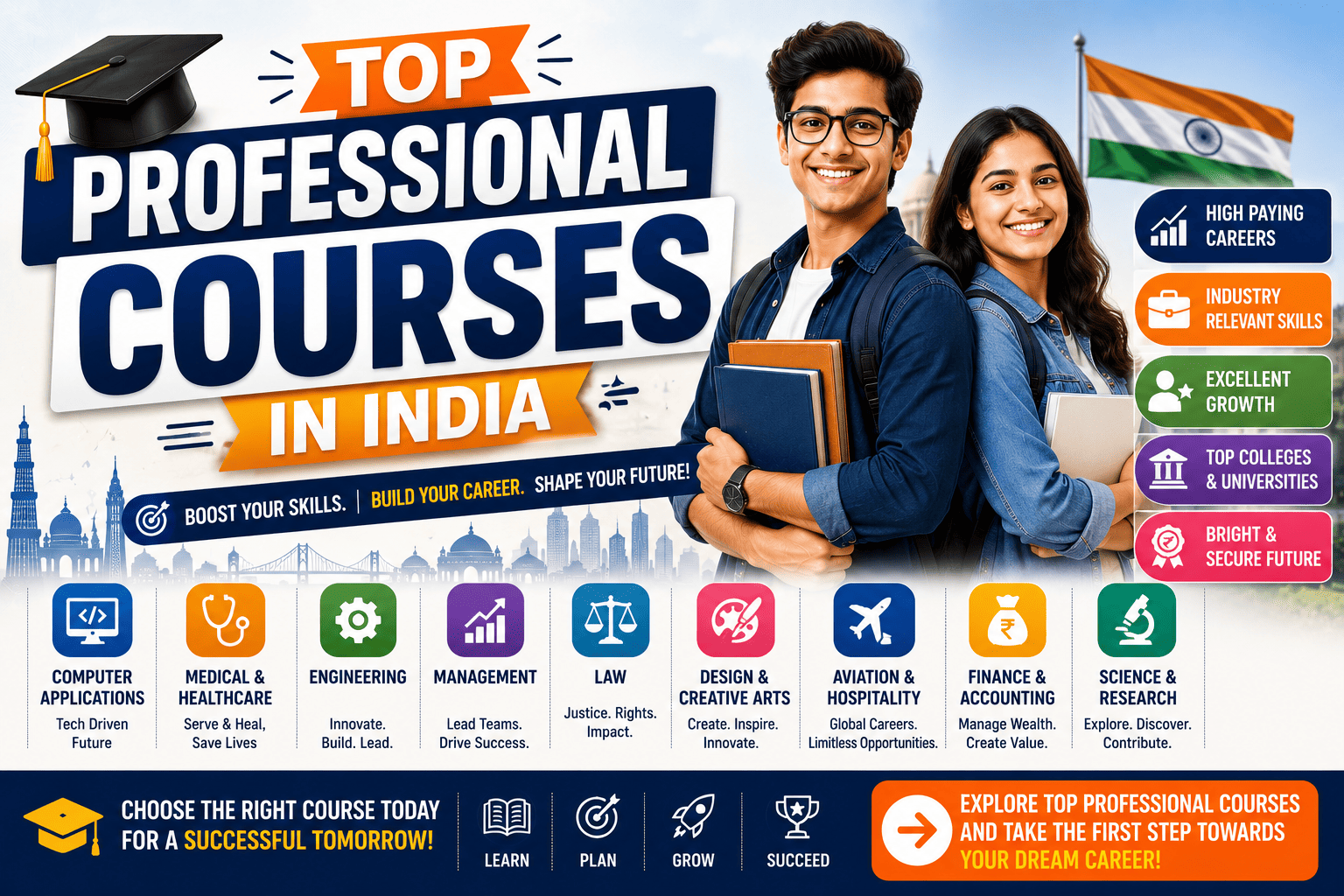


Overview: Best Courses After 12th Science (PCM & PCB)
| Stream | Course | Duration | Type | Starting Salary |
|---|---|---|---|---|
| PCM | B.Tech / B.E. | 4 years | UG Degree | ₹3–10 LPA |
| PCM | B.Arch | 5 years | UG Degree | ₹3–6 LPA |
| PCM | B.Sc. (Physics/Maths/CS) | 3 years | UG Degree | ₹2–5 LPA |
| PCM | NDA / Defence | 3–4 years | Training + Commission | ₹6–10 LPA |
| PCM | Merchant Navy | 3–4 years | UG Degree/Diploma | ₹5–15 LPA |
| PCB | MBBS | 5.5 years | UG Degree | ₹6–15 LPA |
| PCB | BDS (Dentistry) | 5 years | UG Degree | ₹4–8 LPA |
| PCB | B.Pharm | 4 years | UG Degree | ₹3–6 LPA |
| PCB | BAMS / BUMS / BHMS | 5.5 years | UG Degree | ₹3–7 LPA |
| PCB | B.Sc. Nursing | 4 years | UG Degree | ₹3–6 LPA |
| PCM/PCB | B.Sc. Biotechnology | 3 years | UG Degree | ₹2–5 LPA |
| PCM/PCB | BCA / B.Sc. IT | 3 years | UG Degree | ₹3–8 LPA |
| PCM/PCB | B.Des (Design) | 4 years | UG Degree | ₹3–8 LPA |
Top Courses After 12th Science — Detailed Guide
1. B.Tech / B.E. (Bachelor of Technology / Engineering)
B.Tech remains the most popular choice for PCM students. It is a 4-year undergraduate programme available in dozens of specialisations: Computer Science, Mechanical, Civil, Electrical, Electronics, AI & ML, Data Science, and more. Admission is primarily through JEE Main and JEE Advanced for NITs and IITs.
Top Specialisations in 2026: Computer Science & AI, Data Science, Cybersecurity, Robotics, Biomedical Engineering
2. MBBS (Bachelor of Medicine, Bachelor of Surgery)
MBBS is the gold standard for PCB students aspiring to become doctors. The course spans 5.5 years (including a 1-year internship). Admission is through NEET UG — India’s single medical entrance exam. Government MBBS seats are highly competitive; private colleges offer seats via management quota and NRI quota.
3. B.Arch (Bachelor of Architecture)
B.Arch is ideal for PCM students with a creative bent. The 5-year programme trains students in building design, urban planning, and construction technology. Admission is through JEE Paper 2 (B.Arch) or NATA (National Aptitude Test in Architecture).
4. B.Sc. (Pure Sciences)
A 3-year BSc in Physics, Chemistry, Mathematics, Biology, or Computer Science is excellent for students who want to pursue research, teaching, or postgraduate specialisation. Top graduates pursue M.Sc. and then PhD at IISc, TIFR, and IITs. BSc from a good college can also lead to MCA, MBA, or data science careers.
5. BDS (Bachelor of Dental Surgery)
BDS is a 5-year dental degree (including internship) for PCB students who want to practice dentistry. Admission is via NEET UG. After BDS, students can pursue MDS (Master of Dental Surgery) for specialisation.
6. B.Pharm (Bachelor of Pharmacy)
B.Pharm is a 4-year course for PCB students interested in pharmaceutical sciences, drug formulation, and clinical research. Admission is through state-level pharmacy entrance exams or merit-based. Career options include pharma companies, hospitals, and research labs.
7. BCA / B.Sc. Computer Science
BCA (3 years) and B.Sc. CS (3 years) are excellent options for science students who want to enter the IT industry without the full B.Tech commitment. Strong coding skills can land you jobs at top IT companies. BCA students can also pursue MCA for better prospects.
8. B.Sc. Nursing
B.Sc. Nursing is a 4-year degree for PCB students interested in healthcare. With India’s growing healthcare sector and international nursing demand (especially in UK, Canada, Australia), this is an excellent career path. AIIMS, JIPMER, and state nursing councils conduct entrance exams.
9. Merchant Navy (B.Sc. Nautical Science / Marine Engineering)
Merchant Navy offers among the highest salaries for science graduates. PCM students can join through IMU CET (Indian Maritime University) for programmes like B.Sc. Nautical Science or B.E. Marine Engineering. Salaries range from ₹5–15 LPA starting and can reach ₹50+ LPA at senior levels.
10. NDA / Defence Services
PCM students can join the Indian Army, Navy, or Air Force through NDA (National Defence Academy) after 12th. The written exam is conducted by UPSC twice a year. After selection, candidates undergo 3 years of training at NDA followed by 1 year of pre-commissioning training at the respective service academy.
Top Colleges in India — By Course
| Course | Top Colleges | Entrance Exam |
|---|---|---|
| B.Tech | IIT Bombay, IIT Delhi, NIT Trichy, BITS Pilani, VIT | JEE Main / JEE Advanced |
| MBBS | AIIMS Delhi, JIPMER, Maulana Azad Medical College, Armed Forces Medical College | NEET UG |
| B.Arch | IIT Kharagpur, SPA Delhi, CEPT Ahmedabad, NIT Calicut | JEE Paper 2 / NATA |
| B.Sc. | IISc Bangalore, St. Stephen’s Delhi, Presidency College Kolkata, Miranda House | CUET / College Entrance |
| BDS | Maulana Azad Institute of Dental Sciences, Manipal, SDM Dental College | NEET UG |
| B.Pharm | Jamia Hamdard, JSS College of Pharmacy, Manipal College of Pharmaceutical Sciences | State Pharmacy CET / NEET |
| BCA | Christ University, Symbiosis, Amity, Loyola College | Merit / College Entrance |
| B.Sc. Nursing | AIIMS, JIPMER, CMC Vellore, Manipal College of Nursing | AIIMS Nursing / JIPMER |
Salary Comparison After Graduation
| Course | Starting Salary (India) | Mid-Career (5–10 years) | Top Earners |
|---|---|---|---|
| B.Tech (CS/AI) | ₹4–12 LPA | ₹15–40 LPA | ₹50–100+ LPA |
| MBBS + PG | ₹6–15 LPA | ₹20–60 LPA | ₹1 Cr+ (Sr. Consultants) |
| B.Arch | ₹3–6 LPA | ₹10–25 LPA | ₹40–60 LPA |
| B.Pharm | ₹3–5 LPA | ₹8–20 LPA | ₹30–50 LPA |
| Merchant Navy | ₹5–15 LPA | ₹20–50 LPA | ₹60–80 LPA |
| NDA / Officer | ₹6–10 LPA (CTC equiv.) | ₹12–20 LPA | ₹30+ LPA (Generals) |
| B.Sc. Nursing | ₹3–5 LPA (India) / ₹20–40 LPA (abroad) | ₹8–15 LPA | ₹50+ LPA (abroad) |
| BCA / B.Sc. CS | ₹3–7 LPA | ₹10–25 LPA | ₹40+ LPA |
Government vs Private Colleges — Which Is Better?
| Factor | Government College | Private College |
|---|---|---|
| Fees | ₹20,000 – ₹2 LPA | ₹1 – ₹20+ LPA |
| Admission | Merit / Entrance Exam (JEE/NEET) | Management Quota + Entrance |
| Faculty | Experienced, often research-active | Varies widely |
| Infrastructure | Good (IITs/NITs: world-class) | Good to Excellent (premium colleges) |
| Placements | Strong at IITs/NITs/AIIMS | Strong at BITS, Manipal, VIT, Amity |
| Brand Value | IIT/NIT/AIIMS brand is globally respected | Varies — a few well-known private brands |
| Scholarship | Many government scholarships available | Limited institutional scholarships |
Online vs Offline Courses After 12th
| Parameter | Online Courses | Offline (Traditional) Courses |
|---|---|---|
| Cost | Free – ₹2 LPA | ₹20,000 – ₹20 LPA |
| Duration | 3 months – 1 year (mostly) | 3 – 5.5 years |
| Degree | Certificate / Diploma (not always degree) | Full UG Degree |
| Flexibility | High — learn at your own pace | Fixed schedule |
| Networking | Limited (unless cohort-based) | Strong peer networks |
| Practical Training | Limited labs/clinical exposure | Mandatory practicals and labs |
| Recognition | Certificates from Coursera/edX/IITs highly valued in tech | Degree required for many professional roles |
| Best For | Skill upskilling, coding, data science, design | Medicine, Engineering, Architecture, Law |
Scholarships for Science Students After 12th
Financing your education need not be a barrier. Several scholarships are available for Class 12 Science students:
- KVPY (Kishore Vaigyanik Protsahan Yojana) — Now replaced by INSPIRE-SHE scholarship. Supports B.Sc./B.S./B.Stat/B.Math/Integrated M.Sc./M.S. students pursuing science.
- DST INSPIRE Scholarship — ₹80,000/year for top 1% students in Class 12 pursuing B.Sc. or Integrated M.Sc. Apply at inspire-dst.gov.in.
- AICTE Pragati Scholarship — ₹50,000/year for female students in technical degree/diploma programmes.
- National Merit-cum-Means Scholarship — For economically weaker students with strong academic record.
- State Government Scholarships — Each state offers post-matric scholarships for SC/ST/OBC students; check your state’s social welfare department portal.
- Prime Minister’s Scholarship Scheme — For children of ex-servicemen joining professional programmes.
- Tata Trust Scholarships / Reliance Foundation Scholarships — Corporate scholarships for meritorious students from low-income families.
Future Scope of Science Courses
India’s economy is rapidly shifting toward technology, healthcare, renewable energy, and advanced manufacturing. This makes science graduates highly valuable in 2026 and beyond:
- Artificial Intelligence & Data Science — B.Tech CS/AI graduates are among the highest-paid professionals globally. India needs 1 million AI/ML professionals by 2030 (NASSCOM).
- Healthcare & Biotechnology — Post-COVID, India’s healthcare sector has seen massive investment. MBBS, B.Pharm, and Biotech graduates have strong domestic and international demand.
- Renewable Energy & Green Engineering — Engineers in solar, wind, and electric vehicle domains are in high demand as India targets 500 GW of renewable energy by 2030.
- Space & Defence — ISRO, DRDO, and private space startups are creating new avenues for engineering and science graduates.
- Global Opportunities — Indian doctors (via USMLE/PLAB), nurses, IT engineers, and architects have high global mobility.
Tips for Choosing the Right Course After 12th Science
- Assess your strengths honestly — Are you better at problem-solving (PCM) or memorisation/biology (PCB)? Choose a course that plays to your natural strengths.
- Research job market demand — Check NASSCOM, LinkedIn Talent Insights, and government employment reports for in-demand careers before committing.
- Talk to working professionals — A 30-minute conversation with a working doctor, engineer, or architect is worth more than any brochure.
- Consider the return on investment — A ₹20 LPA medical degree that takes 5.5 years has a different ROI than a ₹3 LPA B.Sc. that takes 3 years. Run the numbers.
- Don’t ignore entrance exam cutoffs — Be realistic. Check previous year’s cutoffs for JEE, NEET, and state exams. Aim high but have backup options.
- Explore interdisciplinary programmes — Courses like Bioinformatics, Environmental Science, Data Science, and Biomedical Engineering combine multiple fields and open diverse career paths.
- Look beyond traditional choices — Merchant Navy, Forensic Science, Optometry, and Agricultural Sciences offer excellent careers that are less crowded.
- Check NAAC/NIRF ranking of colleges — Not just the course, but the college matters for placements, faculty, and industry connections.
- Plan for postgraduate education — Some fields (medicine, law, architecture, research) require a PG degree for real career growth. Factor this into your 10-year plan.
- Financial planning matters — Apply for scholarships before finalising a college. High fees with no scholarship can be a long-term burden.
- Stay updated on new-age courses — B.Tech in Quantum Computing, B.Sc. in Genomics, and B.Arch in Sustainable Design are emerging courses with excellent future prospects.
- Take career aptitude tests — Tools like the Holland Code (RIASEC) or DMIT can give data-driven insights into suitable careers.
Common Mistakes to Avoid
- Choosing a course purely based on peer or family pressure without matching it to your own interests
- Not attempting NEET/JEE with full preparation and then regretting it for years
- Ignoring B.Sc. as an option — many top researchers and scientists have B.Sc. degrees from government colleges
- Paying high fees for a private college with poor NAAC rating and no placement record
- Skipping aptitude tests and career counselling sessions
- Choosing a course based on current salary trends without considering future automation risks
- Not applying for scholarships on time — most have early deadlines
- Believing that one exam failure (NEET/JEE) ends your career — drop years are common and many toppers appeared multiple times
- Not considering courses abroad (especially B.Sc. and B.Tech in Canada, Germany, or Australia) where fees may be lower and career prospects stronger
- Neglecting soft skills development — communication, leadership, and teamwork matter as much as technical knowledge in placements
- Choosing a location-specific course without considering relocation flexibility
- Not exploring diploma + lateral entry paths, which can save 1–2 years and reduce costs
Frequently Asked Questions (FAQs)
1. Which is the best course after 12th Science (PCM)?
B.Tech in Computer Science or AI/Data Science is currently the most in-demand and highest-paying course for PCM students. However, “best” depends on your aptitude — those passionate about physics may prefer B.Sc. or research; those inclined toward design may prefer B.Arch.
2. Which is the best course after 12th Science (PCB)?
MBBS is the most prestigious, but it requires cracking NEET with a high score. B.Sc. Nursing, B.Pharm, and BAMS are excellent alternatives with good career prospects and international demand.
3. Can a PCM student do MBBS?
Yes. PCM students who took Biology as an additional subject in Class 11–12 are eligible for NEET and can pursue MBBS. Many students who take Biology as a 5th subject do this successfully.
4. What is the minimum percentage required for B.Tech admission?
Most top colleges (NITs, IITs via JEE) require 75% in PCM in Class 12 (65% for SC/ST). State engineering colleges have lower cutoffs, sometimes 50–60%.
5. Is NEET mandatory for all medical courses?
NEET is mandatory for MBBS, BDS, BAMS, BUMS, BHMS, and B.Sc. Nursing at AIIMS/JIPMER. Some paramedical courses at private institutions have separate entrance exams.
6. What is the scope of B.Sc. after 12th Science?
B.Sc. graduates can pursue M.Sc., MBA, MCA, B.Ed. (teaching), or enter research via IISc/TIFR. Many B.Sc. CS and Maths graduates also transition into IT careers with relevant skills.
7. Which courses after 12th offer the highest salary?
B.Tech in CS/AI (from IIT/NIT), MBBS + MD/MS, and Merchant Navy (senior ranks) offer the highest earning potential in India. Internationally, Medicine, Data Science, and Software Engineering are top-paying fields.
8. Can I change my stream after taking science in 12th?
Yes. Science students can pursue Commerce-related programmes like BBA, CA Foundation, or Humanities-related courses like BA LLB. The transition is generally allowed, though some courses may have subject-specific requirements.
9. Are online degrees valid in India?
UGC-recognised online degrees (offered by IITs, NITs, IGNOU, and approved private universities) are valid for employment. However, for regulated professions (medicine, law, architecture), physical attendance and on-campus degrees are mandatory.
10. How do I prepare for JEE/NEET while finalising my course choice?
Start JEE/NEET preparation in Class 11. Simultaneously research your course options so that by the time results are out, you have a clear priority list — 1st choice, 2nd choice, and backup options. This prevents panic-driven decisions in July–August of admission season.
11. Is B.Sc. Nursing a good career option for boys?
Absolutely. Male nurses are in high demand, especially in ICUs, emergency care, and internationally. Countries like UK, Canada, and Australia actively recruit Indian male nurses. There is no gender barrier in nursing as a profession.
12. Which course has the best work-life balance?
B.Sc. and BCA courses generally offer better work-life balance than MBBS or engineering. Among professional courses, architecture can be demanding in terms of project deadlines. IT careers offer flexibility with remote work options.
13. What are some less-known but excellent courses after 12th Science?
Forensic Science, Occupational Therapy, Radiation Technology, Agricultural Engineering, Environmental Science, Actuarial Science, and B.Sc. in Genomics are excellent but under-explored options with strong job prospects.
Conclusion
The best course after 12th Science is not a single answer — it is the one that aligns with your strengths, interests, career goals, and financial situation. Whether you choose the competitive path of JEE/NEET, the emerging world of data science, or the rewarding field of healthcare, what matters most is clarity of purpose and consistent preparation.
Take time, do your research, speak with mentors, and explore all options before making your final decision. The career you build over the next 10–20 years starts with the choice you make today.
Choose wisely — your future is worth the effort.